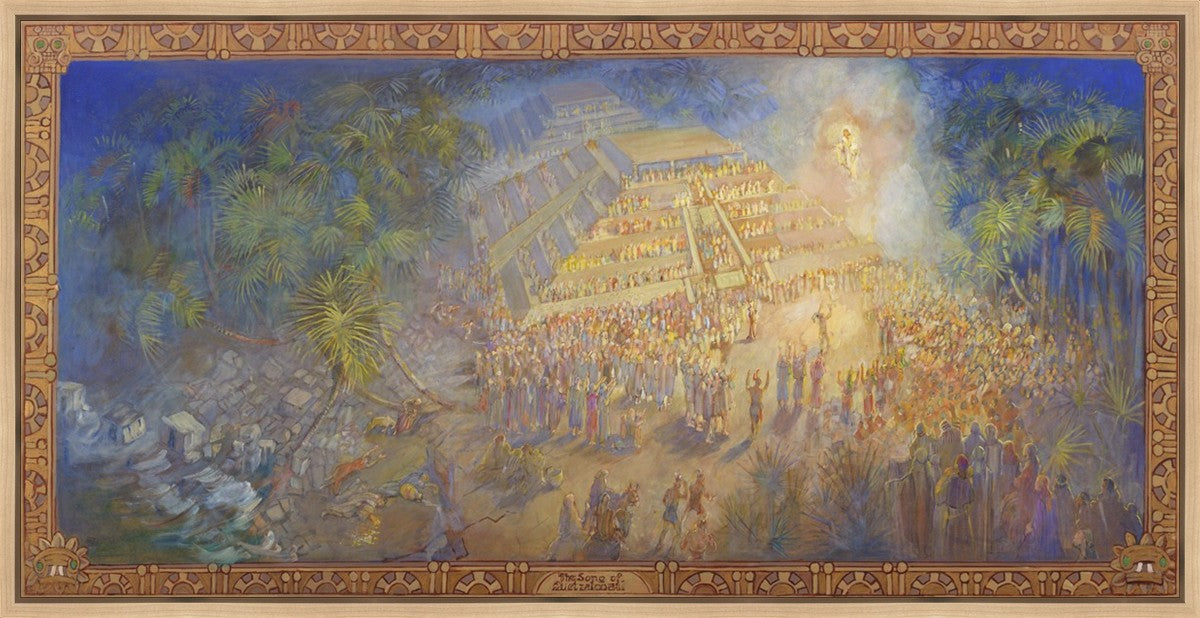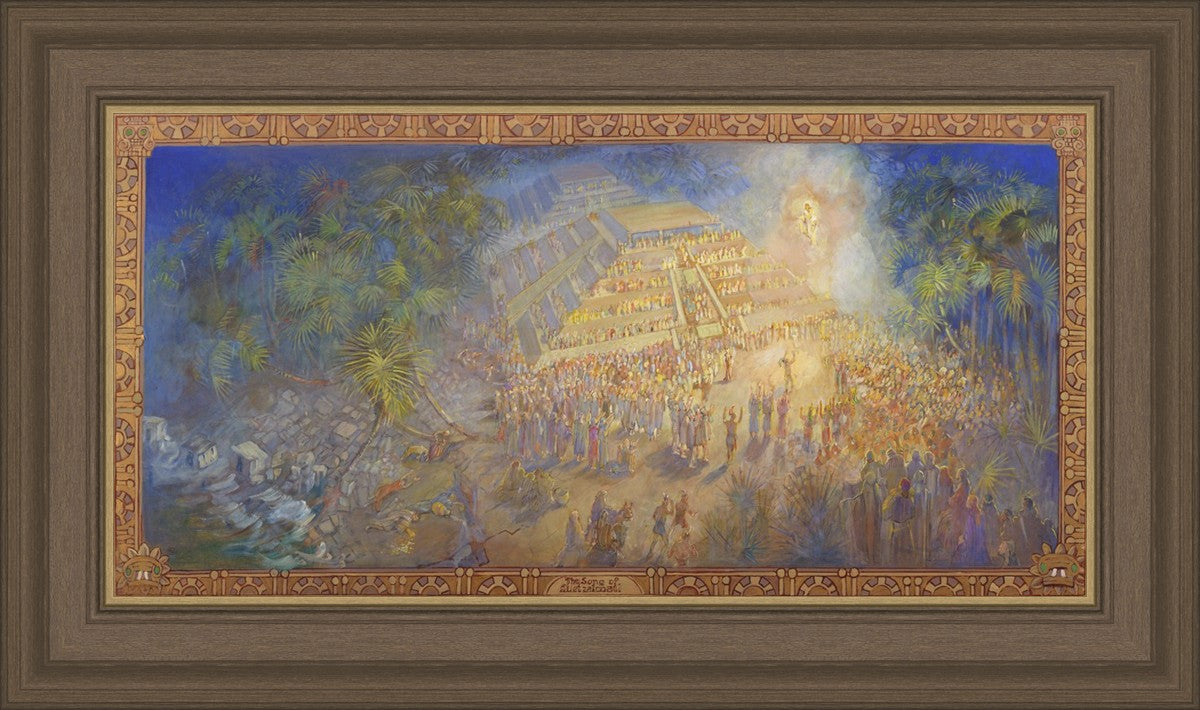


3 Nephi 21:25 - “25 And then shall the power of heaven come down among them; and I also will be in the midst.” 3 Nephi 24:2 - “2 But who may abide the day of his coming, and who shall stand when he appeareth? For he is like a refiner’s fire, and like fuller’s soap.” 2 Nephi 12:12 - “12 For the day of the Lord of Hosts soon cometh upon all nations, yea, upon every one; yea, upon the proud and lofty, and upon every one who is lifted up, and he shall be brought low.” “Teichert associates the legend of Quetzal-coatl with the coming of Christ to the American continent. Central to the main versions of this legend is the story of a bearded white man-god who appeared to some of the ancient American inhabitants. He had large eyes and flowing robes.” “Although Jesus visited the Americas months after the destruction accompanying his crucifix-ion, Teichert merges the two events. Darkness, death, and destruction prevail on the left, and light, life, and salvation on the right. As will occur during the Second Coming, the wicked have been destroyed in the middle of everyday activities; water is still spilling out of one person''s jug, and money is strewn beside its dead owner. In the midst of the wicked is their symbol - a goat (Matthew 25:32). A flood of light accompanies Christ''s entrance, for he is the light of the world. Children run to be closer to him, and Lamanites and Nephites hurry to join in welcoming their Savior. The worshippers are led by both a Laman-ite and a Nephite. In the Lord''s eyes, the significant distinction among people is not one of race, but one of choosing life over death.” “The lower corners of the border bear images of Quetzalcoatl as the feathered serpent. Because this deity "soared" into the heavens at his departure, he became symbolized by the quet-al bird. Another typification of the Savior is the brazen serpent mentioned in some scriptures (Numbers 21:9; 2 Nephi 25:20; Helaman 8:14-15). The combination of serpent (or "coatl") and bird is a motif found in various Mesoamerican art forms.” The plumed Mesoamerican serpent god had various manifestations in numerous ancient cultures. It was especially associated with Mexico, however, due to the letters of Hernán Cortés, who conquered the Aztec empire for Spain in 1521. His writings and later works based on them, such as William H. Prescott''s Conquest of Mexico, a copy of which formed part of Teichert''s library, acquainted the western world with the pyramids at Teotihuacán and the legend of Quetzalcoatl. Prescott described Quetzalcoatl as "that deity with a fair complexion and flowing beard, so unlike the Indian physiognomy who, after fulfilling his mission of benevolence among the Aztecs, embarked on the Atlantic Sea for the shores of Tlapallan. He promised, on his departure, to return at some future day with his posterity, and resume the possession of his empire." “Thematically, this painting parallels the Song of Quetzalcoatl with its contrast between destruction and salvation and its image of coins scattered on the ground next to the dead. Teichert was fond of quoting Isaiah, who proph-esied that Christ will be clothed in red at his second coming (Isaiah 63:2).” “The Temple of Quetzalcoatl at Teotihuacán dates from A.D. 200 to 800, much later than the year 73 B.C. assigned to the account of Captain Moroni. Yet Teichert''s use of the Quetzalcoatl motif in her painting effectively suggests a pre-Columbian setting. Moreover, in the early 1930s the image of Quetzalcoatl had particular significance for both Teichert and the Mormon viewers of her piece. As excavations of ancient American ruins increased in the early twentieth century, Mormons looked for tangible proofs of Book of Mormon authenticity. The legend of Quetzalcoatl had many similarities with the Book of Mormon account of the visit of Christ to the Americas after his crucifixion and resurrection. 57 As a result, early-twentieth-century church publications contained articles on "the gre Quetzalcoatl of the Aztecs and Toltecs," and speeches from the pulpit equated Quetzalcoatl with Christ.” Reproduced from the artist''s original artwork of Oil on Paperboard 48” x 96”. Painted 1955. Reference: The Book of Mormon Paintings of Minerva Teichert by John W. Welch and Doris R. Dant. Reference: Pageants in Paint by Marian Wardle
Shipping & Returns
Shipping & Returns
- For Shipping Policy details, click here.
- For Return Policy details, click here.